Dramatically staged in a Trump-style show, which we hope will have an honorable conclusion (the formal renegotiation of the 1951 Danish-American treaty), the issue of Greenland draws attention to other sensitive locations and areas that could be the subject of future confrontations. The Svalbard archipelago, under Norwegian sovereignty, has been attracting Russian and Chinese interest. Oslo is concerned about this, and its allies, particularly in Europe, would be wrong to downplay the risks and threats.
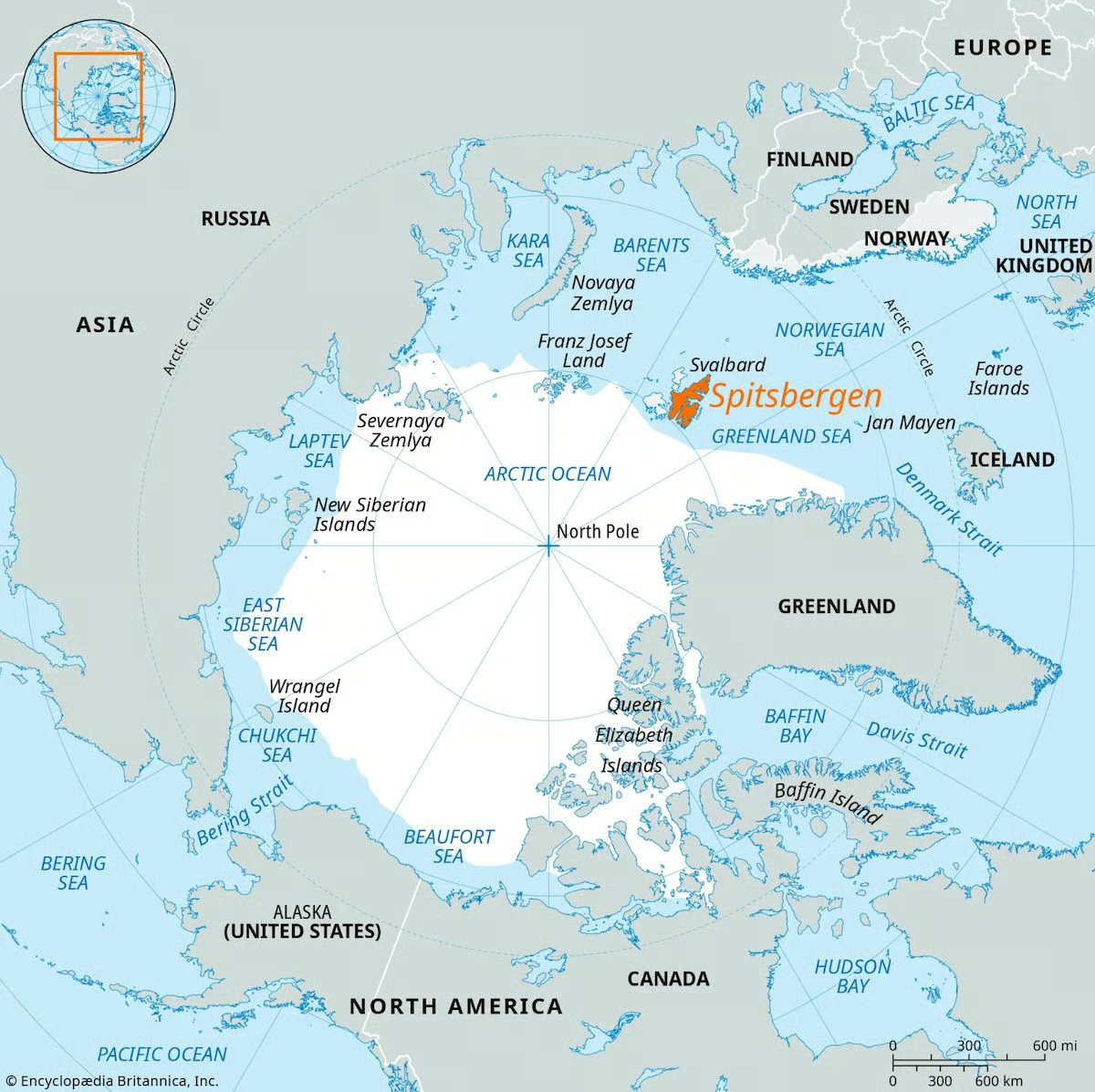
Svalbard (the “Cold Coast”) is an archipelago in the Arctic Ocean, between Greenland (Denmark) to the north, the Franz Josef Land archipelago (Russia) to the east, and Scandinavia to the south. Covering an area of approximately 60,000 sq km, it has a maritime zone of sq 800,000 km. Its main island, Spitsbergen, is home to most of the population, just over 2,600 people (representing fifty nationalities). The administrative capital of the archipelago is called Longyearbyen. Since the Spitsbergen Treaty was signed on February 9, 1920, the archipelago has been under Norwegian sovereignty, with autonomous status1. In return, the territory is demilitarized and the forty countries signatory to the treaty have exploitation rights there. Russia and China are among these countries2.
Between the two world wars, Moscow acquired coal mines from the Netherlands (at the Barentsburg site, 55 km from Longyearbyen), covering an area of 250 sq km. During the Cold War, Norway and its American ally on one side, and the USSR on the other, deployed electronic surveillance systems. In the 1990s, the exploration of hydrocarbon deposits and its implications came to the forefront. However, according to information revealed by the Norwegian website Aldrimer, which specializes in security, defense, and intelligence issues, Russia has deployed military assets and, from Svalbard, conducted reconnaissance operations on critical Norwegian infrastructure (aldrimer.no, September 26, 2019). This information raises the question of Norway’s strategic vulnerability, spectacularly portrayed in the television series Occupied (2015).
Since then, Oslo has become aware of the many important regional geopolitical issues at stake: geostrategic position in the Arctic region, space observation and satellite management, missile trajectory tracking, and ownership and exploitation of natural resources in the surrounding soil and seabed (hydrocarbons, rare earths, and so-called “critical” minerals, which are essential to new technologies and therefore strategic). The Norwegian government has therefore responded to foreign interference and intends to assert its full sovereignty over the Svalbard archipelago, its territorial waters, and its exclusive economic zone3. From now on, non-Norwegian residents will only be eligible to vote in local elections after a certain period of residence (three years). The possibility of purchasing a plot of land in Svalbard, for Norwegians and foreigners alike, is drastically limited4.
This assertion of Norwegian sovereignty has prompted comments and criticism from the states signatory to the 1920 treaty, including the European Union as a whole. Iceland, a culturally close ally of Norway, has itself sent a letter to the Norwegian government contesting its claim to full sovereignty over the waters around the Svalbard archipelago. The Russian Foreign Ministry has stated that it considers any Norwegian exploitation of resources at the bottom of these waters to be illegal.
And Russia does not intend to stop at diplomatic protests and legal quibbles. Arguing that Russia has a long-standing presence in the archipelago and that there is a Russian community of around 300 people in Barentsburg, Moscow is using the Russian Orthodox Church to advance its agenda. An emissary of Patriarch Kirill and priests have been sent to the area to oversee this community and demonstrate Russia’s ambitions. In Moscow, an official recently argued that Svalbard should be renamed the “Pomor Islands,” after the trappers and fur traders who, three hundred years earlier, had come from the Novgorod region to settle in the archipelago5. This gave rise to Russia’s claim to a supposed right to intervene militarily to “protect” the lives, language, and culture of these Russian residents, just as it has done in Ukraine and throughout the post-Soviet space.
Russia’s presence is now overshadowed by that of China, whose nationals have gained a foothold in Svalbard over the past two decades. Chinese scientists residing there work at the Yellow River Station research center in Ny-Ålesund (west of the archipelago). The entrance to the center is flanked by two heavy granite lions, seen as symbols of sovereignty by Chinese tourists visiting the archipelago. Recently, “cruise passengers” from Hong Kong and mainland China displayed flags and banners there, prompting official protests from the Norwegian government to Beijing. Oslo has demanded the removal of these symbols of sovereignty, erected on Norwegian territory, but Beijing has refused.
U.S. officials fear that the Chinese in Svalbard are not limiting themselves to such symbolic displays. Under the guise of space and atmospheric research, these scientists are allegedly conducting military research, which is prohibited by the Svalbard Treaty. The data collected by a powerful radar system is then shared with Chinese military centers.
The Norwegian government is not fooled and, on the recommendation of its intelligence services, has decided to refuse visas to Chinese students wishing to enroll at the archipelago’s only university center (University Center in Svalbard). This wise decision is part of a general policy that is mindful of the geostrategic issues at stake in the Arctic and emerging threats, a policy that also has the merit of anticipating the “considerations” of a powerful ally and protector that can sometimes be invasive. May European nations take inspiration from this, on all fronts that are open or likely to be open in the near future.
Addendum: The Polar Silk Road
The term “Polar Silk Road” refers to a set of Chinese economic, logistical, and geopolitical initiatives and proposals concerning the Arctic and a new polar sea route between Europe and Asia. It is part of the BRI (Belt and Road Initiative) project, which has been extended to the digital sector and even space telecommunications. With this in mind, Beijing has announced the construction of one or more nuclear icebreakers, possibly in cooperation with Russia. Moscow sees this as a sign of the People’s Republic of China’s strong commitment to Russia’s project to revitalize the Northern Sea Route. Chinese state-owned companies have already invested in the exploitation of Russian oil and gas fields in the Arctic (see the holdings of CNPC/China National Petroleum Corporation and the Silk Road Fundin Yamal LNG). Since Russia’s special military operation against Ukraine, i.e., the transition to high-intensity warfare, and the Western sanctions that followed, this Sino-Russian connection has been strengthened. The Polar Silk Road project interferes with the geopolitical issues surrounding the Arctic and Greenland, a virtually independent territory that is coveted by China and, in turn, by the United States.
Associate professor of history and geography and researcher at the French Institute of Geopolitics (University of Paris VIII). Author of several books, he works within the Thomas More Institute on geopolitical and defense issues in Europe. His research areas cover the Baltic-Black Sea region, post-Soviet Eurasia, and the Mediterranean.
Footnotes
- The text in question is also known as the Svalbard Treaty.
- On Sino-Russian cooperation in the Arctic, NATO Supreme Allied Commander Alexus Grynkewich said: “We have seen that in recent years this has manifested itself both in the maritime domain, with an increase in joint patrols, and in the air domain, with joint patrols by long-range bombers. […] We are constantly trying to improve our posture and are considering ways for nations to strengthen our posture in the Arctic.“ (Le Figaro, January 22, 2026)
- Among the minerals identified under the waters of Svalbard, in addition to rare earths, are copper, zinc, and cobalt. In January 2024, the Norwegian government announced a deep-sea exploration campaign, but then postponed its decision under pressure from environmentalists and left-wing parties.
- The government owns and controls 99% of the land but does not intend to allow free access to the remaining 1% of private property (a royal decree of 2024 emphasizes the preservation of “national security interests”). Several potential buyers, from Norway, Europe, and North America, have initiated legal proceedings and launched a lobbying campaign targeting Norwegian elected officials and decision-makers.
- ‘Pomor’ means ‘seaside dweller’. The historical paradox lies in the fact that the ‘Pomors’ of yesteryear were often of Norwegian descent. In truth, today’s Russian settlers have little in common with their predecessors, as their ancestors came to work in the coal mines after the Bolsheviks signed the Svalbard Treaty.